The Googlisation of Surveillance
As promised, here is my submission to the Joint Parliamentary Committee considering the UK government's Draft Communications Bill:
On Open Enterprise blog.
As promised, here is my submission to the Joint Parliamentary Committee considering the UK government's Draft Communications Bill:
The Draft Communications Bill [.pdf] is one of the most controversial pieces of UK legislation proposed in recent years - not least because it represents a betrayal of election promises by the coalition to roll back state surveillance in the UK. As usual, the government is attempting to claim that current plans are "different" because the databases are distributed, not centralised; but the fact that searches will be possible across all the decentralised holdings means that there is no practical difference. This is quite simply another example of politicians promising one thing to get elected, and then doing its opposite.
One of the most important messages in the history of free software – and computing – was posted 21 years ago, on 25 August 1991:
It seems a long while ago now, but June was a pretty hectic month in this neck of the woods, since it saw the final push to get ACTA rejected in the European Parliament. But of course, plenty of other things were happening then, and one in particular that I wanted to cover was the release of this UK Open Data White Paper entitled "Unleashing the Potential".
Although the following is a little outside the mainstream of Open Enterprise, it does have a very clear moral with direct relevance to this blog's readers. It concerns the proprietary program Sibelius, which describes itself as "the world’s best-selling music notation software". It only runs on Windows and Macintosh, and comes with an oppressive DRM that places it about as far away from free software as is possible. Nonetheless, it seems widely-loved by most of its users, presumably because it does what they want it to.
As I noted recently, net neutrality is back in the spotlight, so I thought it would be useful - and maybe entertaining - to look at an anti-net neutrality article for the insights it gives us about how the other side views things. It's called "Pick Up On One and Let The Other One Ride", and appears in the Huffington Post. Here's how it frames the discussion:
As the old joke goes, standards are wonderful things, that's why we have so many of them. But who would have thought that ETSI, the European Telecommunications Standards Institute, has already produced a draft standard on how European governments can snoop on cloud-based services like Facebook and Gmail -- even when encrypted connections are used?
Recently we wrote about how copyright rules designed for an analog age were causing problems when transposed without modification to the digital world. Here's another example, this time from Australia, where the Brisbane Times' site reports on an increasingly difficult situation in education as a result of outdated copyright approaches:
At the end of last year, I wrote about the great service Barnes & Noble had performed by drawing back the curtain on one of Microsoft's patent lawsuits.
When the UK Hargreaves Review of intellectual monopolies in the digital age came out last year, Techdirt noted that one of its innovations was an emphasis on basing policy on evidence. The fact that this was even notable shows how parlous the state of policy-making has become. One important way to gather evidence is through public consultations, and in the wake of the Hargreaves Review, the UK government conducted a major exercise in gathering views and information in this field.
I have been writing about the Internet Corporation for Assigned Names and Numbers, ICANN, since its birth in 1998 (see the ICANN entry on Wikipedia for a good summary of how that came about, and the evolution of the organisation since then.) That move was contentious at the time, since it saw the running of the Internet's basic infrastructure taken out of the hands of the geeks, personified by Jon Postel, and put in the hands of the business world. As a fully intended side-effect of that move, it also placed the system fully under the control of the US, rather than allowing a more distributed, global approach to evolve.
Last year Techdirt wrote about the almost unbelievable Meltwater decision in the UK, where the courts said that viewing a Web page without the owner's permission was copyright infringement. In November last year, leave was granted to Meltwater to make an appeal against the ruling to the UK's Supreme Court. However, that still leaves the inconvenient matter of the infringement by tens of millions of UK Web users hundreds of times every day in the meantime.
I've written a couple of articles recently about Ofcom's consultation on the implementation of the Digital Economy Act. That consultation has closed now (it was only open for a month), but I'm conscious that in those posts I was making quite a lot of technical claims about Internet security, an area in which I am certainly no expert.
It's something of a truism that the courts take time to catch up with technology, especially in the fast-moving world of the Internet, but Thomas Steen points us to a recent court decision in Norway where the gulf between law and life is particularly wide. The case concerns a blogger called Eivind Berge who was arrested recently on account of some statements on his blog that allegedly "glorified and encouraged the killing of policemen" as a report on the Dagbladet newspaper site puts it (Norwegian original.) Moreover:
Yesterday I wrote that I hoped to post here my submission to the important EU consultation on net neutrality that is currently open. However, there have been some important developments in this area that need to be covered first.
The implicit justification for various new copyright enforcement laws, such as the "three strikes" approach, is that they will encourage people to buy more authorized digital goods and thus support artists and their works. Naturally, those in favor of this logic like to produce figures that purport to show that it is working.
Last week I wrote about the extremely short consultation period for aspects of implementing the Digital Economy Act. Time is running out - the consultation closes tomorrow at 5pm, so I urge you to submit something soon. It doesn't have to be very long. Here, for example, is what I am sending - short, but maybe not so sweet....
One of the recurrent themes here on Techdirt is the increasing lack of balance in copyright, which is now heavily weighted in favor of creators and their proxies, and against the public. That bias has come about thanks to the rise of the Internet, which has turned the traditionally rather specialist area of copyright law and enforcement into a matter of everyday concern: it affects practically everything we do online, and can criminalize even the most trivial of activities there.
Last week, the British policeman Simon Harwood was acquitted of killing a man during the 2009 G20 protests in London -- a controversial verdict given the video footage of the incident. In order not to prejudice their views, the jury was not informed that Harwood had been investigated a number of times previously for alleged violence and misconduct.
Net neutrality is one of those areas that most people are vaguely in favour of, without giving it much thought. Governments take advantage of this to make sympathetic noises while doing precisely nothing to preserve it. For example, following a UK consultation on net neutrality two years ago, Ofcom came out with a very wishy-washy statement that basically said we think net neutrality is a jolly good idea but we won't actually do anything to protect it.
One of the defining characteristics of the digital world -- and one of the problems for copyright law, which was conceived in an analog age -- is the importance of being able to build on the work of others not just indirectly, but directly, through mashups or the re-use of existing material. Stig Rudeholm points us to a fascinating feature in the Guardian about "sweded movies": home-made tributes to Hollywood titles that adopt precisely this approach of creative re-interpretation. The name apparently comes from the film "Be Kind Rewind", where DIY imitations of studio favorites are passed off as Swedish editions.
Last month we wrote about a new copyright law in Japan whose punishments seemed so disproportionate it was hard to take it seriously. For example, downloading unauthorized copies or backing up content from a DVD were both subject to criminal penalties. According to this story from Daily Yomiuri Online, it looks like it's no joke:
They say that a lie is halfway around the world before the truth has got its boots on, and the same seems to be true about Internet policy: the bad ideas spread like wildfire, while the good ones languish in obscurity. Snooping on the Net activity of an entire population is the latest example: now Australia wants to join the club that currently consists of the US and UK, with Canada waiting in the wings. Here's part of the EFF's excellent summary of what the Australian government is proposing:
Recently, Techdirt reported on the ruling by a German court on the issue of filtering -- whether Internet sites have a responsibility to block files continually if they have been notified about infringing materials once, sometimes called "Notice and Stay Down". The German court basically said they do, but the highest French court has taken a different view (French original.)
As I and many others noted at the time, the Digital Economy Act was one of the most disgraceful abuses of the parliamentary process in recent years. It was a badly-drafted bill, with lots of glaring problems, but it was pushed through a near-deserted House of Commons in the dying hours of the previous government. Despite its incorrect premises, shoddy framing and outright final stupidities, it is still hauling its unlovely carcass through the implementation process after several legal challenges failed to put it out of its misery.
Openness is really beginning to sweep through the European Union at all levels. Yesterday we wrote about the European Commission's ambitious plans to make the results of publicly-funded research freely available as open access; now comes news of a major opening up in the world of pharmaceutical data:
I've written elsewhere about how open access - the idea that academic research paid for by the public should be freely available online - was directly inspired by open source. So it's great to see open access making huge strides recently, including the following:
Yesterday, Techdirt reported on the UK government's plans to make publicly-funded scientific research freely available as open access. One concern was that its approach required funds to be diverted from research to pay for the article processing charges levied by so-called "gold" open access titles. One figure being bandied around was about $80 million per year, but a new report in the Guardian suggests this is a huge over-estimate, and that the true cost will be more like a fifth of that figure.
There is a natural tendency to concentrate on what is happening locally, and so most of the stories here on Open Enterprise are about what's happening in the UK, or developments that affect it directly. But it's important to remember that open source is a global development, and that things are bubbling away everywhere, all the time.
One of the great divides in the digital world is between those who believe that people who share files online are selfish, thieving pirates who just want something for nothing, and those who see them simply as ordinary people who want to swap cool stuff with the world. The first group views them as a canker eating at the heart of the music industry, while the second sees them as providing free marketing to the artists concerned. What evidence we have supports the latter view -- not least because the music industry is thriving, not dying as you might expect if piracy were a problem.
Techdirt often writes about the benefits of openness and sharing. One area that is increasingly coming to the fore is open data -- for example, for some time both the US and UK have had major projects aimed at opening up the stores of data held by their respective governments, and other countries are rapidly joining the club. But amidst all the enthusiasm for such projects, it's easy to get swept away, and to accept the idea of open data uncritically. That's what makes this fascinating blog post entitled "Seeing Like a Geek" from Tom Slee so valuable, because he calls out what he sees as a serious problem with open data initiatives:
As expected, Russia has passed a law that will allow Web sites to be blacklisted, ostensibly to "protect children". According to this AFP report, the very vague "harmful information" category has been narrowed somewhat, but future threats remain:
A common feature of democracies is that new laws are scrutinized and debated by representatives of the people before they are passed -- the hope being that bad proposals can be amended or discarded. Laws giving governments the power to change other laws with only minimal oversight are therefore generally regarded as a Bad Thing. But that's exactly what the UK government plans to introduce, as this article on the Out-Law.com site explains:
Music collection societies often figure in Techdirt thanks to their attempts to wring licensing payments from people on absurd grounds, like trying to make them pay for playing music to horses, or for singing old folk songs. But in Europe, there's another issue. Because each country has its own music collection society, digital music startups wishing to operate across Europe must negotiate not one, but dozens of separate licenses – a major obstacle to overcome.
Net neutrality arguments are often couched in rather theoretical terms, and many people can't really see what all the fuss is about. A recent decision in South Korea gives a handy example of what the loss of net neutrality means in practice:
As Techdirt has noted, the main threat to artists is not piracy, but obscurity -- the fact that few know they are creating interesting stuff. As passive consumers increasingly become creators themselves, and the competition increases, that's even more of an issue. For writers, there's a double problem: not only do people need to hear about a work, they also have to find the time to explore it once acquired, and that's often a challenge in our over-filled, stressed-out lives -- unless we're talking about haiku. Here's an unusual approach to encouraging people to find that time to read books:
A few years back, Techdirt noted that India had 16,000 licensed drug manufacturers in the 1990s, and became a net exporter of pharmaceutical products. Things changed somewhat when India joined the WTO, which forced it to recognize pharmaceutical patents, but more recently it has started moving back towards generics, notably with the compulsory licensing of a kidney and liver cancer drug that was being sold by Bayer in the country for around $70,000 a year.
The UK government's communications review is likely to have a big impact on the digital world. As part of that investigation, the Department for Culture, Media and Sport (DMCS) is organising five seminars to canvas people's views on various aspects of communications. These are:
In the arguments over ACTA, one criticism seemed widely accepted: that it tries to bundle together two quite different challenges -- tackling counterfeit goods, like fake medicines, and dealing with unauthorized file sharing. One popular suggestion was that ACTA should be split in two in order to handle those separately – for example, David Martin, the politician who played a key role in convincing the European Parliament to reject ACTA this week, supports this approach.
Even in the face of a resounding rejection of ACTA by the European Parliament last week, the European Commission seems determined to keep pushing for its eventual adoption. Techdirt noted some ways in which it might try to do that, but an important article by Michael Geist lays out what seems to be an alternative approach that is already close to fruition:
A couple of weeks ago I wrote about the danger that the Unitary Patent would usher in software patents to Europe. The proposal was supposed to be voted upon last week in the European Parliament's plenary session, but was postponed, thanks to our very own David Cameron.
Normally, we think of the US as the champion of patenting "anything under the sun that is made by man," while the UK is generally more reticent. So it's rather surprising to find the roles reversed in the following story about a new standard for the GPS navigation system:
One of the most important moments in the rise of a radical idea is when the fightback begins, because it signals an acceptance by the establishment that the challenger is a real threat. That moment has certainly arrived for open access, most obviously through moves like the Research Works Act, which would have cut off open access to research funded by the US government. That attack soon stalled, but the sniping at open access and its underlying model of free distribution has continued.
Orphan works (or maybe that should be "hostage works") have become a really hot area in the copyright debate. That's because increasing numbers of people have realized how insane the current situation is whereby millions of older works, that are out of print and have no obvious owners, remain locked away because of copyright. This has led to various proposals around the world to liberate them, while still protecting the copyright holders if they later appear and assert ownership.
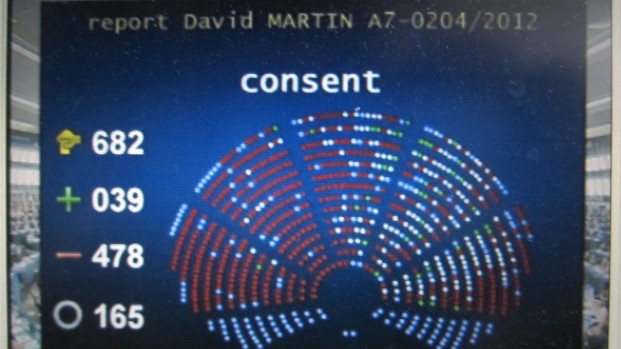
Well, we did it: ACTA was resoundingly defeated in the European Parliament yesterday by 478 votes to 39, with 165 abstentions. That's largely because so many of us contacted our MEPs, wrote emails and even took to the streets. Leaving aside the victory in itself, that's important too because people across Europe have worked together on a massive scale in the defence of the Internet and its freedom.
Along with ridiculous libel cases, the UK is also infamous for laws that are designed to stop people hurting the feelings of others. Maybe that's a laudable aim, but the end-result is that they can cast a chill over freedom of speech. Here's a classic case from the English town of Boston in Lincolnshire:
Although all eyes have been on the European Parliament this week, that doesn't mean things have stopped elsewhere in the EU machine. In particular, the European Court of Justice, the highest in the EU, has just delivered a stunning and really quite unexpected judgment that could have major implications for the digital world.
In a plenary vote today, the European Parliament has rejected ACTA by 478 votes to 39, with 165 abstentions. That followed a failed attempt by the right-of-center EPP Group to call for a postponement. Although the final result was not totally unexpected, since the signs had been pointing this way for a time, it nonetheless represents a huge victory for campaigners who had more or less given up hope of stopping ACTA in Europe even a few months ago. So the question now becomes: what are the ramifications?
If you watched the stream of the plenary session in the European Parliament yesterday, you will know that what we saw was an incredible parade of politicians from all parties denouncing ACTA - with one exception. The centre-right EPP Group is asking for a decision on ACTA to be postponed until after the European Court of Justice hands down its judgement on the compatibility of the treaty with EU law. That's likely to take a year or two, and amounts to a massive delaying tactic, as I've explained before.
Well, never a dull moment in the world of ACTA. After I wrote yesterday's column summing up what I thought was the final state of play, things got very interesting in Strasbourg. Rumours swirled that the right-of-centre EPP Group would be trying to use the agenda meeting last night to call for ACTA to be postponed. After a flurry of excitement, nothing happened then. But a little later, this tweet was posted on the EPP Group account:

 Posts
All Comments
Posts
All Comments

To the extent possible under law,
glyn moody
has waived all copyright and related or neighbouring rights to
this work.
This work is published from:
United Kingdom.